
A DISTRIBUTED NETWORK
Artmuseo is building a shared foundation for the art world — one powered by its community, not by centralized servers.
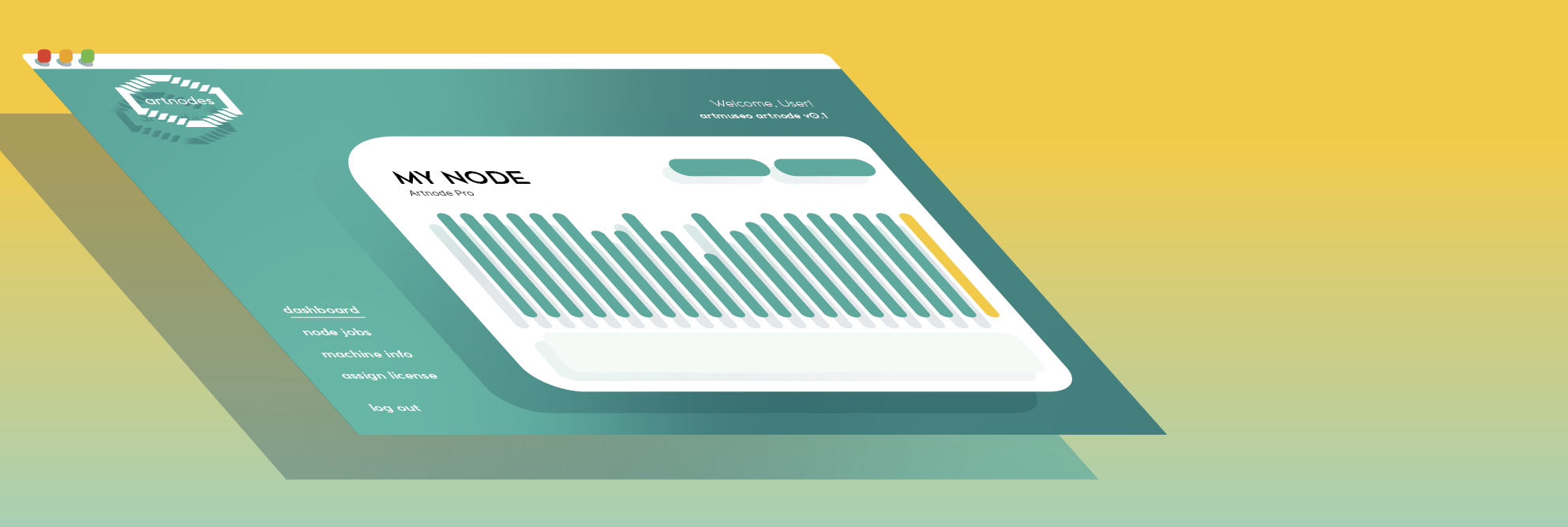
Artnodes Technical Deep Dive
The Artmuseo network runs on a hybrid system that blends private distributed storage with platform-level governance. Each Artnode contributes computing power, storage, and uptime to keep the Artmuseo ecosystem alive and decentralized. Together, these nodes form a private IPFS network, managed and secured through the Artmuseo API and control layer.
At its core, every Artnode serves artworks, metadata, and ownership records for the Artmuseo platform. This network ensures that artworks — whether digital pieces or records of real-world collections — remain available, verifiable, and safely stored across a global web of independent operators.
Artnode License Options
Artnode
This standard node license is valid for 2 years. Auto-renewable and requires 20GB SSD allocation, at least 2 CORES, 8GB Ram minimum with internet speeds of >75gbps. Initial Requirements*
Artnode Pro
The pro node license doesn't expire. Designed for serious contributors with access to powerful machines. requires 100GB SSD allocation, at least 8 CORES, 16GB Ram minimum with internet speeds of >100 gbps. Initial Requirements*
There are two Artnode license tiers — ArtNode and ArtNode Pro — both running the same software but offering different capabilities and economic weight within the network.
A standard ArtNode is designed for all who want to participate in the network with minimal setup. It carries a 2-year renewable license, offering a base reward rate. If not renewed within its grace period, the node stops earning rewards and eventually loses swarm access until re-licensed.
An ArtNode Pro license, on the other hand, is a lifetime membership. It’s meant for hardcore supporters/operators and institutions that want to host significant portions of the network’s data. Pro nodes hold a four-times higher reward weighting, increased replication quotas, and elevated bandwidth allocation. They represent the long-term backbone of the network — reliable, high-uptime peers that keep the system robust and redundant.
Before purchasing, read terms of sale agreement:
https://nodes.artmuseo.io/termsofsale
Architecture and Control Plane
Artnodes operate inside a private IPFS swarm, isolated by a unique swarm key that only licensed nodes possess. This keeps the network permissioned and secure while maintaining the efficiency and resilience of IPFS. Each node communicates through Artmuseo’s control plane, a system that governs authentication, data replication, health monitoring, and reward accounting.
The control plane acts as the network’s heartbeat. It manages which nodes store which artworks, verifies that content is replicated according to policy, and collects uptime signals and service proofs. Rather than relying on human intervention, the network is self-balancing: if a node drops offline, its pinned content is redistributed across others automatically.
All data transfers pass through encrypted libp2p channels, with gateway requests handled by the Artmuseo API. This architecture combines the performance of distributed storage with the administrative visibility needed for compliance, provenance, and fair reward distribution.
Proof of Service, Uptime, and Quality
The Artnode network doesn’t pay for idle machines; it rewards measurable contribution. Each node continuously reports signed heartbeats that confirm uptime and responsiveness. The control plane performs random challenge–response checks, requesting specific content IDs to verify that nodes hold what they claim.
Uptime is tracked as a rolling weekly average, with full rewards awarded at or above 95 percent availability. Nodes that dip below this threshold still receive partial credit, but the reward rate scales down linearly until it reaches zero for chronic downtime. Latency, delivery rates, and successful verification responses are all factored into each node’s quality score, encouraging real, useful performance rather than empty presence.
Reward Distribution
Rewards flow through the Artmuseo platform ledger, which functions as the economic layer of the ecosystem until the on-chain bridge activates. Each day marks an epoch in which the network calculates total contributions and distributes rewards proportionally.
Every node has a base weight according to its license type — one point for standard ArtNodes and four points for ArtNode Pros. This weight is multiplied by uptime and quality factors to determine the node’s share of the daily reward pool. The formula is simple but effective: consistent performance and high reliability earn significantly more tokens.
When the bridge to the blockchain goes live, these same rewards will mint directly on Solana at a one-to-one rate with platform tokens, maintaining continuity and transparency between off-chain and on-chain economies.
For more information on rewards and emissions read about the token
artmuseo token infoPrivate IPFS Implementation
The private IPFS system is the backbone of the Artnode network. Unlike public IPFS, which is open to any peer, Artmuseo’s version operates as a closed, licensed swarm. Each peer joins the network only after authenticating through the Artmuseo API, which verifies license status and issues a swarm key. This ensures that only verified operators can store and distribute Artmuseo content.
Data inside the swarm is stored as content-addressed objects, meaning every file is identified by its hash rather than a location. This guarantees integrity — if a single byte changes, the ID changes too. Nodes pin encrypted CAR files containing images, metadata, and provenance records. The control plane ensures every file has at least five live replicas, with Pro nodes prioritized for the first copies due to their higher uptime guarantees.
Sensitive data, such as ownership certificates or transaction records, is encrypted before upload. The result is a network that protects both the availability and the privacy of cultural assets.
Economics and Weighting
Reward weighting establishes a clear economic hierarchy between node types while preserving fairness across the network. ArtNodes receive a base weight of one point, while ArtNode Pros carry four. This weighting reflects the investment in hardware, uptime, and capacity that Pro operators bring to the network.
A Pro node running at 99 percent uptime with a perfect quality score can earn roughly four and a half times the reward of a regular node at similar performance. All calculations are transparent and viewable in the dashboard, where each license owner can see their uptime, weighted score, and projected earnings per epoch.
The emission pool for node rewards is derived from forty percent of total platform tokens. Over time, as the network grows, these pools follow a decreasing schedule to preserve long-term sustainability while rewarding early operators most generously.
Security and Compliance
All network security is rooted in the private IPFS build integrated with the Artmuseo API. Each node’s identity key is license-bound, and all API requests pass through mutual TLS channels. Gateways handle authentication, rate limiting, and access control directly, ensuring no unauthorized reads or writes occur.
The control plane anonymizes analytics and strips personally identifiable data before logs are stored. Content ownership remains with the submitting artist, and Artmuseo’s compliance framework aligns with GDPR and CCPA standards.
Containers are signed, verified, and locked down at runtime. The system enforces patch compliance automatically — any node running outdated software is paused until updated. In this way, Artmuseo achieves the rare balance of decentralized architecture with centralized-quality security oversight.
The Path Forward
Artnodes now serve artist sites, distribute media across the platform, and run the fingerprinting pipeline that gives every archived work a verifiable visual signature. They are the storage and compute layer beneath the Artmuseo Archive today, not a promise of one tomorrow.
What comes next is the provenance layer. As the Archive matures, each work will carry its fingerprint, metadata, and ownership history into an on-chain record — laying the groundwork for resale attribution and artist royalties administered through Solana.
The nodes that serve Artmuseo's apps today become the custodians of art history tomorrow, preserving cultural data while sustaining a circular economy that rewards the people who keep it alive.